Comparison
Alternatives to Warehouse Inventory Counting Systems
Warehouses count stock in six main ways: by hand, with barcode scanners, with RFID tags, by weight, with drones, or with AI vision cameras. This page compares them on accuracy, cost, speed and setup effort, so you can pick the right method for each point in your flow.
At a glance
What are the alternatives to warehouse inventory counting systems?
The main alternatives are manual counting and cycle counts, handheld or fixed barcode and QR scanning, RFID tags with readers, weighing scales, inventory drones, and AI vision counting with cameras. Each trades cost against accuracy and setup effort. Vikbot, an Indian AI warehouse automation company in Chennai, builds AI vision counting: cameras count and verify items as they move, with no tags and with photo proof.
- Use case
- Choosing how to count stock at receiving, storage, packing and dispatch
- Technology
- Manual, barcode and QR, RFID, weight, drones and AI vision compared
- Deployment
- Vikbot systems run on-premises and offline and connect to your ERP or WMS
- Industries
- Warehouses, manufacturing, FMCG, pharma, logistics and distribution
- Company
- Vikbot, a brand of Clofus Innovations Pvt. Ltd., Chennai, India
Comparison
Inventory counting methods compared
A plain comparison of the common methods. Accuracy and cost depend on your items, volumes and installation, so treat this as a starting point.
| Method | How it works | Accuracy | Cost | Speed | Setup effort |
|---|---|---|---|---|---|
| Manual counting and cycle counts | Staff count stock by hand on paper or a tablet, in full counts or rolling cycle counts | Varies with fatigue, shift and volume; errors grow at scale | Low equipment cost, high labour cost | Slow; operations often pause | Minimal |
| Handheld barcode or QR scanners | Staff scan a code on each item, carton or location | High per scan when codes are readable; missed and double scans happen | Low to medium | One scan at a time | Low; needs labelled goods and a system to scan into |
| Fixed barcode scanners and tunnels | Scanners over a conveyor read codes as cartons pass | High for well-placed, readable labels | Medium | Fast on a conveyor | Medium; label position must be consistent |
| RFID tags and readers | Readers detect radio tags on items or cartons, many at once | High when tags read reliably; metal and liquids can interfere | High: a tag per item plus readers | Very fast; no line of sight needed | High; tagging and reader tuning |
| Weighing scales | Quantity is inferred from total weight and unit weight | Good for uniform items; weak for mixed or variable weights | Low to medium | Fast per batch | Low; needs accurate unit weights |
| Inventory drones | Drones fly aisles and scan rack labels or tags | Good for high-rack location checks; not for moving goods | High | Fast for tall racks | High; safety rules, mapping, labels |
| AI vision counting (cameras) | Cameras count, identify and verify items as they move, with photo proof | High for trained items and stable installation; confirmed per site | Medium; can reuse existing cameras | Counts while goods move; no extra step | Medium; cameras, a short training period, ERP link |
Where Vikbot fits
AI vision counting from Vikbot
CountBot
AI inventory counting on a smart conveyor at dispatch counters, packing stations and receiving.
Read morePackBot
Checks every item that goes into a box before it is sealed, with a photo, timestamp and packer on record.
Read moreDockBot
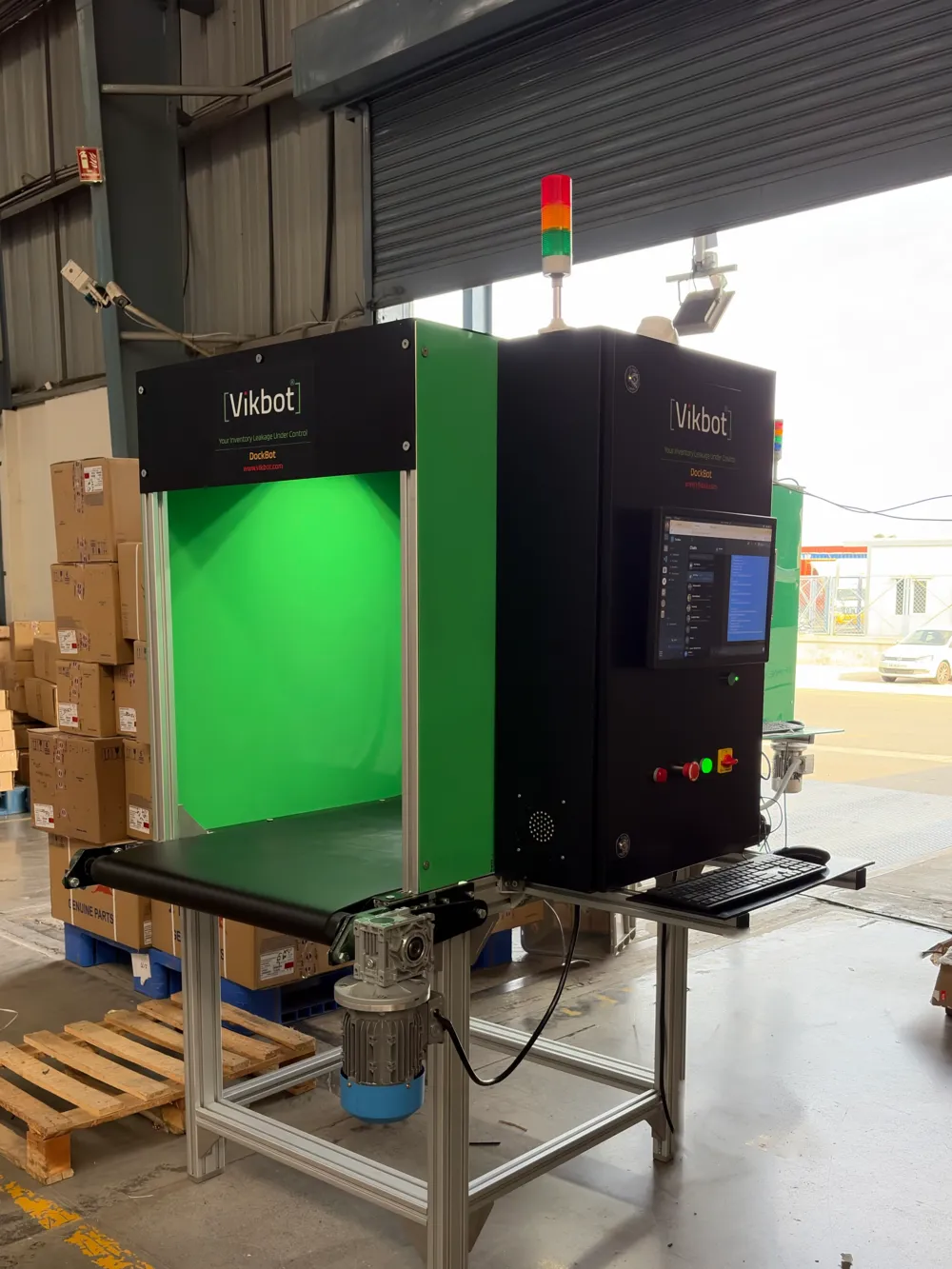
Checks every item against the invoice at the loading dock and blocks wrong, short and excess dispatches.
Read moreScanBot
Mobile barcode, QR and full-label scanning for picking, putaway and FIFO/FEFO, with no item master.
Read moreVikbot WMS
Keeps stock by location and changes it only when a bot verifies the movement, so full counts are needed less often.
Read moreHow to choose
Pick the method for each point
Start with the costliest errors
- Wrong, short or excess dispatches: verify at the dock with DockBot or Dispatch Tracker.
- Miscounts at packing: count every unit with CountBot or check every box with PackBot.
- Expired or wrong-batch picks: read the full label with ScanBot.
Match the method to the goods
- Low volume with good labels: handheld barcode or QR scanning is often enough.
- High-value goods already tagged: RFID can read many items at once.
- High-volume cartons and mixed SKUs: AI vision counts without tags or one-by-one scans.
FAQ
Counting alternatives frequently asked questions
What are the alternatives to warehouse inventory counting systems?
Is RFID better than barcode scanning for inventory counting?
How does AI vision counting work?
Can AI vision counting replace cycle counts completely?
Which counting method should a warehouse start with?
Request a Demo
See how AI vision counting would work at your dispatch counter, packing station or loading dock.